MoreExam
1. Question Content...
EXPLANATION
Answer: X - EXPLANATION Content.
Question1: Refer to the exhibit.This Mule application is deployed to multiple Cloudhub workers with persistent queue enabled. The retrievefile flow event source reads a CSV file from a remote SFTP server and then publishes each record in the CSV file to a VM queue. The processCustomerRecords flow's VM Listner receives messages from the same VM queue and then processes each message separately.How are messages routed to the cloudhub workers as messages are received by the VM Listener?
Question2: A mule application uses an HTTP request operation to involve an external API.The external API follows the HTTP specification for proper status code usage.What is possible cause when a 3xx status code is returned to the HTTP Request operation from the external API?
Question3: A new upstream API Is being designed to offer an SLA of 500 ms median and 800 ms maximum (99th percentile) response time. The corresponding API implementation needs to sequentially invoke 3 downstream APIs of very similar complexity. The first of these downstream APIs offers the following SLA for its response time: median: 100 ms, 80th percentile: 500 ms, 95th percentile: 1000 ms. If possible, how can a timeout be set in the upstream API for the invocation of the first downstream API to meet the new upstream API's desired SLA?
Question4: An organization uses a four(4) node customer hosted Mule runtime cluster to host one(1) stateless api implementation. The API is accessed over HTTPS through a load balancer that uses round-robin for load distribution. Each node in the cluster has been sized to be able to accept four(4) times the current number of requests.Two(2) nodes in the cluster experience a power outage and are no longer available. The load balancer directs the outage and blocks the two unavailable the nodes from receiving further HTTP requests.What performance-related consequence is guaranteed to happen to average, assuming the remaining cluster nodes are fully operational?
Question5: An organization is evaluating using the CloudHub shared Load Balancer (SLB) vs creating a CloudHub dedicated load balancer (DLB). They are evaluating how this choice affects the various types of certificates used by CloudHub deployed Mule applications, including MuleSoft-provided, customer-provided, or Mule application-provided certificates. What type of restrictions exist on the types of certificates for the service that can be exposed by the CloudHub Shared Load Balancer (SLB) to external web clients over the public internet?
Question6: What is a key difference between synchronous and asynchronous logging from Mule applications?
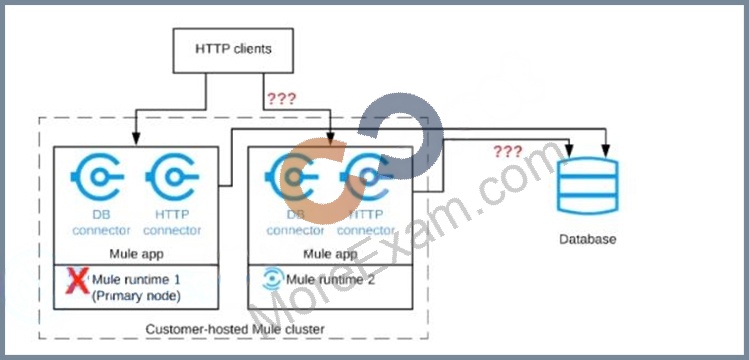
Question7: Refer to the exhibit.A Mule application is deployed to a cluster of two customer-hosted Mute runtimes. The Mute application has a flow that polls a database and another flow with an HTTP Listener.HTTP clients send HTTP requests directly to individual cluster nodes.What happens to database polling and HTTP request handling in the time after the primary (master) node of the cluster has railed, but before that node is restarted?
Question8: An API implementation is being developed to expose data from a production database via HTTP requests. The API implementation executes a database SELECT statement that is dynamically created based upon data received from each incoming HTTP request. The developers are planning to use various types of testing to make sure the Mule application works as expected, can handle specific workloads, and behaves correctly from an API consumer perspective. What type of testing would typically mock the results from each SELECT statement rather than actually execute it in the production database?
Question9: Mule application A receives a request Anypoint MQ message REQU with a payload containing a variable-length list of request objects. Application A uses the For Each scope to split the list into individual objects and sends each object as a message to an Anypoint MQ queue.Service S listens on that queue, processes each message independently of all other messages, and sends a response message to a response queue.Application A listens on that response queue and must in turn create and publish a response Anypoint MQ message RESP with a payload containing the list of responses sent by service S in the same order as the request objects originally sent in REQU.Assume successful response messages are returned by service S for all request messages.What is required so that application A can ensure that the length and order of the list of objects in RESP and REQU match, while at the same time maximizing message throughput?
Question10: An XA transaction Is being configured that involves a JMS connector listening for Incoming JMS messages. What is the meaning of the timeout attribute of the XA transaction, and what happens after the timeout expires?
Question11: A team would like to create a project skeleton that developers can use as a starting point when creating API Implementations with Anypoint Studio. This skeleton should help drive consistent use of best practices within the team.What type of Anypoint Exchange artifact(s) should be added to Anypoint Exchange to publish the project skeleton?
Question12: As a part of business requirement , old CRM system needs to be integrated using Mule application. CRM system is capable of exchanging data only via SOAP/HTTP protocol. As an integration architect who follows API led approach , what is the the below step you will perform so that you can share document with CRM team?
Question13: A retailer is designing a data exchange interface to be used by its suppliers. The interface must support secure communication over the public internet. The interface must also work with a wide variety of programming languages and IT systems used by suppliers.What are suitable interface technologies for this data exchange that are secure, cross-platform, and internet friendly, assuming that Anypoint Connectors exist for these interface technologies?
Question14: A global organization operates datacenters in many countries. There are private network links between these datacenters because all business data (but NOT metadata) must be exchanged over these private network connections.The organization does not currently use AWS in any way.The strategic decision has Just been made to rigorously minimize IT operations effort and investment going forward.What combination of deployment options of the Anypoint Platform control plane and runtime plane(s) best serves this organization at the start of this strategic journey?
Question15: What is not true about Mule Domain Project?
Question16: Organization wants to achieve high availability goal for Mule applications in customer hosted runtime plane. Due to the complexity involved, data cannot be shared among of different instances of same Mule application. What option best suits to this requirement considering high availability is very much critical to the organization?
Question17: How are the API implementation , API client, and API consumer combined to invoke and process an API ?
Question18: An organization is evaluating using the CloudHub shared Load Balancer (SLB) vs creating a CloudHub dedicated load balancer (DLB). They are evaluating how this choice affects the various types of certificates used by CloudHub deplpoyed Mule applications, including MuleSoft-provided, customer-provided, or Mule application-provided certificates.What type of restrictions exist on the types of certificates that can be exposed by the CloudHub Shared Load Balancer (SLB) to external web clients over the public internet?
Question19: A Mule application uses the Database connector.What condition can the Mule application automatically adjust to or recover from without needing to restart or redeploy the Mule application?
Question20: An organization is designing the following two Mule applications that must share data via a common persistent object store instance:- Mule application P will be deployed within their on-premises datacenter.- Mule application C will run on CloudHub in an Anypoint VPC.The object store implementation used by CloudHub is the Anypoint Object Store v2 (OSv2).what type of object store(s) should be used, and what design gives both Mule applications access to the same object store instance?
Question21: Insurance organization is planning to deploy Mule application in MuleSoft Hosted runtime plane. As a part of requirement , application should be scalable . highly available. It also has regulatory requirement which demands logs to be retained for at least 2 years. As an Integration Architect what step you will recommend in order to achieve this?
Question22: Refer to the exhibit.A Mule application is being designed to expose a SOAP web service to its clients.What language is typically used inside the web service's interface definition to define the data structures that the web service Is expected to exchange with its clients?
Question23: A set of integration Mule applications, some of which expose APIs, are being created to enable a new business process. Various stakeholders may be impacted by this. These stakeholders are a combination of semi-technical users (who understand basic integration terminology and concepts such as JSON and XML) and technically skilled potential consumers of the Mule applications and APIs.What Is an effective way for the project team responsible for the Mule applications and APIs being built to communicate with these stakeholders using Anypoint Platform and its supplied toolset?
Question24: An organization has decided on a cloudhub migration strategy that aims to minimize the organizations own IT resources. Currently, the organizational has all of its Mule applications running on its own premises and uses an premises load balancer that exposes all APIs under the base URL https://api.acme.com As part of the migration strategy, the organization plans to migrate all of its Mule applications and load balancer to cloudhub What is the most straight-forward and cost effective approach to the Mule applications deployment and load balancing that preserves the public URLs?
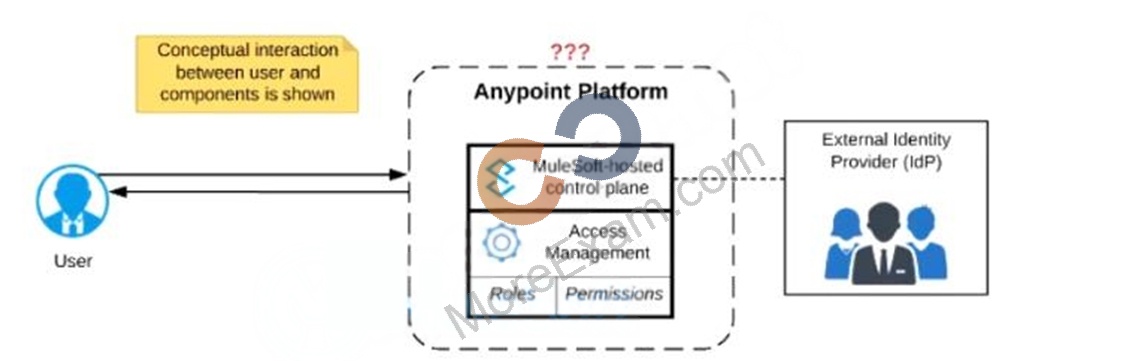
Question25: Refer to the exhibit.Anypoint Platform supports role-based access control (RBAC) to features of the platform. An organization has configured an external Identity Provider for identity management with Anypoint Platform.What aspects of RBAC must ALWAYS be controlled from the Anypoint Platform control plane and CANNOT be controlled via the external Identity Provider?
Question26: A Mule application contains a Batch Job with two Batch Steps (Batch_Step_l and Batch_Step_2). A payload with 1000 records is received by the Batch Job.How many threads are used by the Batch Job to process records, and how does each Batch Step process records within the Batch Job?
Question27: What requires configuration of both a key store and a trust store for an HTTP Listener?
Question28: An integration Mute application is being designed to process orders by submitting them to a backend system for offline processing. Each order will be received by the Mute application through an HTTPS POST and must be acknowledged immediately. Once acknowledged, the order will be submitted to a backend system. Orders that cannot be successfully submitted due to rejections from the backend system will need to be processed manually (outside the backend system).The Mule application will be deployed to a customer-hosted runtime and is able to use an existing ActiveMQ broker if needed.The backend system has a track record of unreliability both due to minor network connectivity issues and longer outages.What idiomatic (used for their intended purposes) combination of Mule application components and ActiveMQ queues are required to ensure automatic submission of orders to the backend system, while minimizing manual order processing?
Question29: An API has been unit tested and is ready for integration testing. The API is governed by a Client ID Enforcement policy in all environments.What must the testing team do before they can start integration testing the API in the Staging environment?
Question30: An Organization has previously provisioned its own AWS VPC hosting various servers. The organization now needs to use Cloudhub to host a Mule application that will implement a REST API once deployed to Cloudhub, this Mule application must be able to communicate securely with the customer-provisioned AWS VPC resources within the same region, without being interceptable on the public internet.What Anypoint Platform features should be used to meet these network communication requirements between Cloudhub and the existing customer-provisioned AWS VPC?
Question31: What is true about the network connections when a Mule application uses a JMS connector to interact with a JMS provider (message broker)?
Question32: An external REST client periodically sends an array of records in a single POST request to a Mule application API endpoint.The Mule application must validate each record of the request against a JSON schema before sending it to a downstream system in the same order that it was received in the array Record processing will take place inside a router or scope that calls a child flow. The child flow has its own error handling defined. Any validation or communication failures should not prevent further processing of the remaining records.To best address these requirements what is the most idiomatic(used for it intended purpose) router or scope to used in the parent flow, and what type of error handler should be used in the child flow?
Question33: A company is building an application network and has deployed four Mule APIs: one experience API, one process API, and two system APIs. The logs from all the APIs are aggregated in an external log aggregation tool. The company wants to trace messages that are exchanged between multiple API implementations. What is the most idiomatic (based on its intended use) identifier that should be used to implement Mule event tracing across the multiple API implementations?
Question34: An organization has various integrations implemented as Mule applications. Some of these Mule applications are deployed to custom hosted Mule runtimes (on-premises) while others execute in the MuleSoft-hosted runtime plane (CloudHub). To perform the Integra functionality, these Mule applications connect to various backend systems, with multiple applications typically needing to access the backend systems.How can the organization most effectively avoid creating duplicates in each Mule application of the credentials required to access the backend systems?
Question35: A Mule application is being designed To receive nightly a CSV file containing millions of records from an external vendor over SFTP, The records from the file need to be validated, transformed. And then written to a database. Records can be inserted into the database in any order.In this use case, what combination of Mule components provides the most effective and performant way to write these records to the database?
Question36: An organization is creating a set of new services that are critical for their business. The project team prefers using REST for all services but is willing to use SOAP with common WS-" standards if a particular service requires it.What requirement would drive the team to use SOAP/WS-* for a particular service?
Question37: 49 of A popular retailer is designing a public API for its numerous business partners. Each business partner will invoke the API at the URL 58. https://api.acme.com/partnefs/vl. The API implementation is estimated to require deployment to 5 CloudHub workers.The retailer has obtained a public X.509 certificate for the name apl.acme.com, signed by a reputable CA, to be used as the server certificate.Where and how should the X.509 certificate and Mule applications be used to configure load balancing among the 5 CloudHub workers, and what DNS entries should be configured in order for the retailer to support its numerous business partners?
Question38: What is true about automating interactions with Anypoint Platform using tools such as Anypoint Platform REST API's, Anypoint CLI or the Mule Maven plugin?